
Joe Arridy: The Happiest Man on Death Row
You stand there, gazing through a thick glass window into the faintly lit chamber. A flimsy man occupies the chair situated at the focal point of the little room with a smile on his face. You know what’s going on and why he’s here, but he doesn’t have the foggiest idea of what’s happening. As two guards exit the chamber and firmly shut the door behind them, you can’t resist the urge to allow the tears to fall as the young man in the seat grins at you one final time.
The young man depicted in the preceding paragraph is Joe Arridy. Before we get to his story, I will talk about his early life. Joe Arridy was born on April 29, 1915, in Pueblo, Colorado, to Syrian parents Henry and Mary Arridy. His parents emigrated to the United States in 1909, and his father worked for the Colorado Fuel & Iron Works. Joe was an only child during his first few years of life, and although he was physically well, he had mental problems.
Joe’s condition was evident when he entered first grade and could not keep up with the other children. With the advice of his school principal during Joe’s second year at school, Joe stayed at home for the next three years, playing and wandering as children do.
The Arridy had another boy in 1923 and a daughter the following year. Henry Arridy soon quit his job and began bootlegging to support his family. His mother Mary could not keep up with Joe since Henry was constantly in and out of jail, and Joe was developing quickly with an addition to his other two siblings. Since his parents could not supervise him well, they decided to ask the neighbors what to do with him. The neighbors, who generally disliked them, recommended sending him to the Training School for Mental Defectives at Grand Junction. Unfortunately, the school was pretty much an insane asylum.
Joe was allowed to join the asylum. The workers at the asylum tested Joe and discovered that his IQ was 46, the mind of a six-year-old. The workers determined that he was a follower of rules and was a person wanting to please others. However, nine months later, Henry started to miss his son and have second thoughts about sending him to the center. He successfully petitioned a judge to have Joe released. Joe was released. Despite his father’s concerns, Joe was still poorly supervised and wandered around the city by himself.
In September 1929, Joe got into an incident where he was surrounded by a group of older African American boys, who forced him to perform sexual acts on/with them. However, a passing officer caught the boys performing sexual acts toward Joe and saved him from them. The officer sent a letter back to his state home and requested for Joe to return back to the asylum. Joe was taken back to the asylum and was monitored by staff to watch him and stop him from pervasive activity. During Joe’s entire stay in the asylum, there was never a single case about sexual activity regarding Joe.
Beside the asylum were the Union Pacific railroad tracks, and it was not unusual for patients to escape by train. On August 9, 1936, Joe with three others got on a train and headed to Pueblo. However, they wandered around and went back to Grand Junction. After three days, the other three gave up their journey, but Joe continued, and on August 20, he arrived at Cheyenne, Wyoming. There, he found a job washing dishes for several days in exchange for food on a kitchen car run by Mr. and Mrs. Glenn Gibson. During this time, the train went to many places, but Joe was returned to the East Cheyenne railyards, where he was arrested by railroad detectives and sent to Laramie County Sheriff George J. Carrol.
Sheriff Carroll was a unique person. He was loved by the press, knew how to work with people, and was a trusted figure. His interest in Joe was stimulated after learning that he came from Pueblo since there was an incident in his hometown where R.O. McMurtry and Sally Crumpley were attacked and where Crumpley was killed. Another incident occurred thirteen days later when Dorothy Drain and Barbara were attacked where Drain was killed, and Barbara was left in a coma. The police believed the perpetrator of both of the crimes were the same people due to the similarity of the crime.
Joe was in a tight spot coming from Pueblo, escaping an insane asylum and having a record of sexual behavior. After interrogation, Carroll contacted Chief J. Arthur Grady in Pueblo, stating that he found a person that said he killed Drain. Over the next three hours, they exchanged phone calls, after which Joe was purportedly able to provide details of the crime. There is no physical evidence of what was said between Carroll and Joe, only what Carroll remembered and said. Carroll convinced Grady that Joe was the perpetrator, even though they found a suspect named Frank Aguilar having a hatchet with the same characteristics as the one that cut Drain’s head at his house. Grady had evidence but no confession, while Carroll had a confession but no evidence.
Grady did not want to announce an arrest without solid evidence, but Carroll was the opposite. After he came up, with a good story, he went to the press. The news about Joe was spread all over the world, and no one doubted Carroll, even though he gave false details and embellished the story. Conveniently, the Pueblo Police found a witness placing Joe in town at the time of the crimes. A pawnbroker named Saul Kahn claimed he sold a cheap pistol to a guy named Joe Arridy, not Joe Arridy. The confusing thing was Joe never had money to start with and did not even know how to count.
The suspicions hardened when Joe blurted out “That’s Frank!” at Chief Grady’s office. Joe was, of course, very impressionable and just wanted to please others. The two crimes were not even possible for him because he was still in an asylum when they occurred. The detectives did not care about this as they were eager to pin Frank for the crimes and needed Joe’s help to do so.
Frank Aguilar stood up to interrogation for the next few days, and he finally confessed on September 2. Unlike Joe’s confession, Aguilar’s confession was taken by an actual court reporter. He admitted that he committed the crime but only mentioned Joe when he was asked about Joe. His story was that he met Joe by chance and found out he was a “sexual deviant.” He said he told Joe about his plan and said Joe went along with it. They broke into their house and raped and killed Dorothy, and knocked out Barbara. Joe being an agreeable self, agreed with the story.
On December 15, 1936, Frank Aguilar was brought onto trial for rape, assault, and murder of Barbara and Dorothy Drain, Mrs. R. O. McMurtree, and Sally Crumpley. Dorothy’s little sister, Barbara, who recovered from her coma, testified against Frank. The jury took little time to make their decision and came with a guilty verdict on Frank.
Frank was sentenced to death by the gas chamber, and during the entire court case, Joe was never brought up. Joe had a court-appointed attorney named C. Fred Bernard, who worked to prove his innocence. Joe pleaded not guilty by reason of insanity and had to have a separate trial to determine his sanity and see if he could have a murder trial. Joe was examined by three state psychiatrists, who all said that he was incapable of differentiating right and wrong and, therefore, would be unable to perform an action with malicious intent. Joe was asked simple questions to which he answered without knowing the answer or understanding the question.
Then, he was asked questions to show that he knew what he was in court for. Unsurprisingly, Sheriff George Carroll’s testimony went against Joe, stating that he knew when people could understand right from wrong with his experience with criminals. After this testimony, the jury found Joe to be legally sane, therefore being tried for murder.
Joe’s trial began on April 12, 1937. Bernard and Ralph J. Neary argued back and forth. The only evidence Neary had was Saul Kahn and hair that was supposedly found at the crime scene. Bernard claims that the hair was only discovered after Joe’s arrest, not after the crime. He argues that the hair was not taken from the scene but from Joe after being arrested. However, his claims did not fully persuade the jury because of Sheriff George Carroll stepping in. Carroll was a showman and easily manipulated the court. Carroll was able to recite the dialogue between Joe and himself during Joe’s confession, even mimicking Joe’s lack of vocabulary. Bernard did everything he could, but Carroll’s testimony sealed Arridy’s fate. After a long deliberation for three and a half hours, the jury found Joe to be sane and guilty of murder and rape. Joe was sentenced to death by the gas chamber.
On August 11, 1937, it was reported that the $1,000 reward was given to Sheriff Carroll and the railroad detectives that turned Joe over. Two days later, Aguilar was executed. Joe’s execution date was moved back due to Warden Best’s interest in Joe. Best tried his best by arranging to get Joe an appeals lawyer, Gail Ireland, who kept the case alive on the insanity part. Ireland hoped to transfer the case to a judge in Fremont Count but failed due to the Colorado Supreme Court ruling that the case belonged to Pueblo.
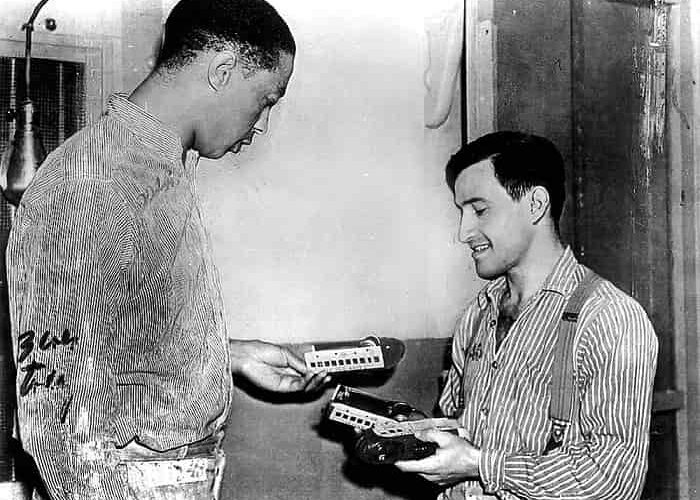
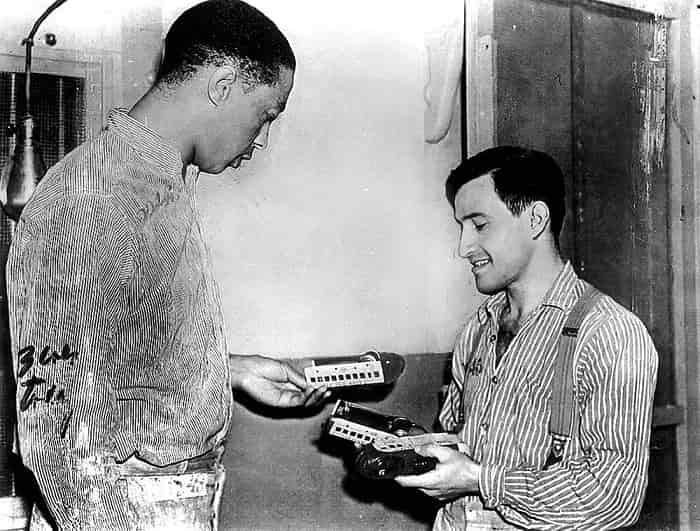
Joe was happy during his time on death row for a year and a half. He polished metal food plates and used them as a mirror, making faces and talking to them. Best tried his best to make him happy by giving him a book with pictures and scissors for Joe to cut out the pictures. However, Joe’s favorite thing was the bright red wind-up car, with battery-powered headlights and a toy train given to him by Best. Joe played with the car and shouted, “Car wreck!
Car wreck!” whenever the car smashed into something or tipped over. He also played with the train rolling it down the passageway in front of death row cells. Even his neighbors, all killers, were patient with him.
As his execution day approached, he was interviewed by the press, and the reporters loved his story. When one of the reporters asked the question, “Don’t you want to go back to the home in Grand Junction?” Joe replied, “No, I want to get a life sentence and stay here with Warden Best. At home, the kids used to beat me. I never get in trouble here.” According to a Cañon City reporter, Joe was oblivious of the mounting tension and did not know that the state wanted to take his life.
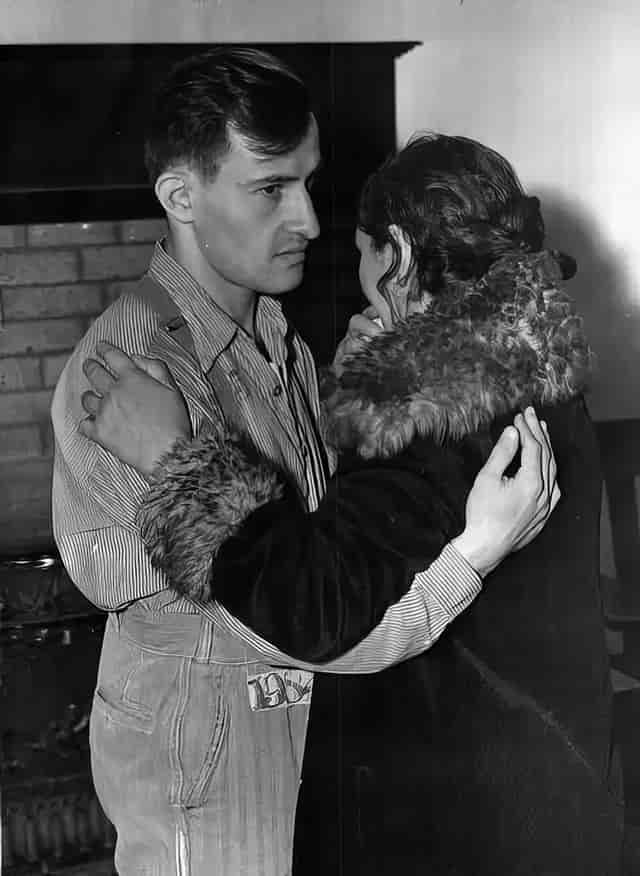
On January 5, 1939, Best asked Joe what he would like for his last meal. Joe replied, “Ice Cream.” Best also brought Joe a box of cigars and a massive amount of homemade candy. Joe ate with his heart’s content and gave the rest away. On the next and last day, Joe was visited by his family members. His father had died 11 months earlier.
When his mother saw him, she burst into tears, but Joe didn’t comprehend anything and happily returned to his cell. He spent the rest of the day smoking cigars, eating candy, and playing with his train. Joe gave his precious train to one of his inmates before going into the gas chamber. As he sat down for his final moments, he was happily chattering about raising chickens and playing the harp. Joe Arridy truly was “The Happiest Man on Death Row.”
Source: Troy University